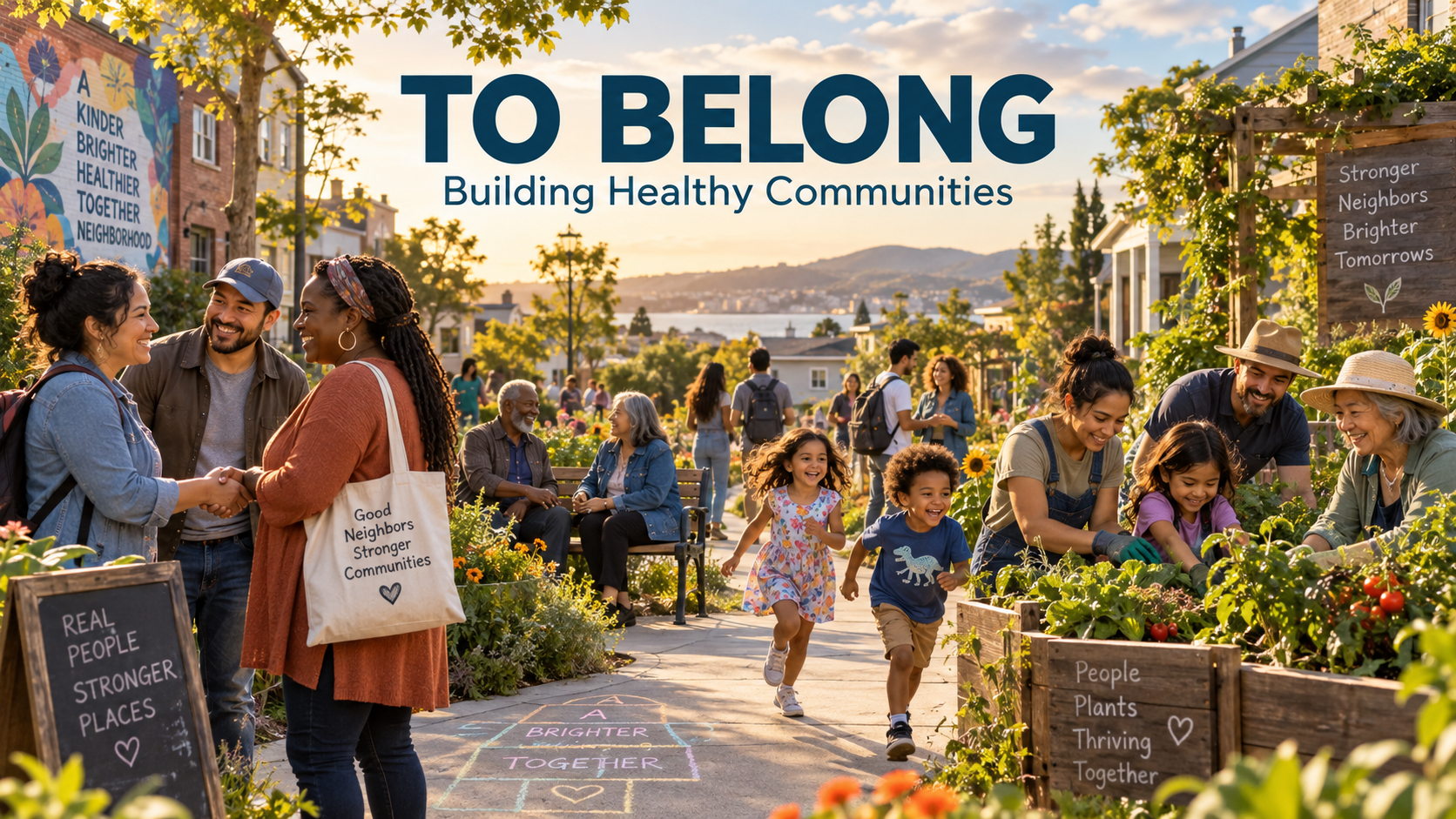
Building Healthy Communities
 Dr. Amichai Dovid Graber
Why belonging, trust, and opportunity matter
A healthy community is more than a place where people live. It is a network of relationships in which people are known, respected, supported, and given meaningful opportunities to contribute. Strong communities help children develop, protect mental and physical health, preserve shared values, and give families a stronger foundation for the future.
Yet many communities are weakening. Trust is declining, social isolation is increasing, and too many families are separated from stable housing, useful work, education, and the relationships that make progress possible. Rebuilding community requires more than good intentions. It requires practical action centered on human dignity.
Community Shapes the Next Generation
Children are influenced not only by their families and schools, but also by the wider environment surrounding them. Developmental psychologist Urie Bronfenbrenner showed that neighbors, institutions, mentors, and cultural expectations all affect a child’s growth.
Young people learn by watching how adults respond to hardship, exercise authority, settle disagreements, and treat those with less power. When a community models integrity, responsibility, and compassion, children learn that they belong and that their choices matter. Without that support, isolation and hopelessness can take root.
Connection Protects Health
Meaningful social relationships are closely connected to better mental and physical health. Research has associated strong social ties with lower risks of depression, illness, and premature death. Isolation, by contrast, can intensify emotional distress, substance misuse, and chronic health problems.
Health is therefore about more than medical care. It is also shaped by housing stability, safety, nutrition, purposeful work, emotional support, and trustworthy relationships. A strong community notices when someone is struggling and responds before a manageable hardship becomes a lasting crisis.
What Healthy Communities Value
Human dignity. Every person has value, regardless of income, age, ability, background, or belief. Inclusion does not mean abandoning standards. It means creating fair opportunities for people to belong, accept responsibility, and contribute.
Purpose over comparison. Envy turns another person’s success into a perceived personal loss. Healthy communities help people recognize their own strengths and use them in service of something larger than themselves.
People above profit alone. Economic growth matters, but it should serve human progress. A community’s success should also be measured through health, safety, education, stability, belonging, and access to opportunity.
Pathways to independence. Effective assistance addresses immediate needs while helping people build long-term stability. Attainable housing, workforce training, mentorship, education, entrepreneurship, and ownership can change the direction of an entire family.
Why Communities Break Down
Trust is the foundation of cooperation. Scholar Francis Fukuyama connects social capital—the ability to work together for shared purposes—directly to trust. When people believe institutions serve only those with wealth or influence, participation declines and relationships become increasingly transactional.
Trust cannot be restored through slogans. It must be earned through transparent leadership, fair decisions, consistent accountability, and results people can see in their daily lives.
Turning Neglected Places into Shared Opportunity
One of the most practical ways to rebuild community is to transform abandoned and distressed properties into places that serve people. Vacant homes can become attainable housing. Empty storefronts can support local businesses. Unused land can provide food, training, recreation, and gathering spaces.
This is more than real-estate redevelopment. Done responsibly, it creates a platform for employment, education, entrepreneurship, health, and belonging. It allows residents to participate in rebuilding their own community rather than being treated merely as recipients of assistance.
David’s Dream Fund advances this people-centered approach by supporting practical projects that transform neglected places and distressed enterprises into measurable pathways to housing, health, work, and opportunity. The objective is not simply to improve property. It is to build human capacity and create communities in which people can move forward together.
Building What Matters
A healthy society does not promise that no one will struggle. It ensures that struggle does not make a person invisible. It combines personal responsibility with genuine opportunity, meaningful relationships, and accountable support.
When communities protect dignity, restore trust, and turn overlooked resources into shared opportunity, they do more than respond to social problems. They create the conditions in which people, families, and future generations can flourish.
Invest. Partner. Build What Matters.
Selected Research
Bronfenbrenner, U. (1979). The Ecology of Human Development. Harvard University Press.
Fukuyama, F. (1995). Trust: The Social Virtues and the Creation of Prosperity. Free Press.
Holt-Lunstad, J., Smith, T. B., and Layton, J. B. (2010). Social Relationships and Mortality Risk. PLoS Medicine, 7(7), e1000316.
MacIntyre, A. (1981). After Virtue. University of Notre Dame Press.